← All projectsFIRST Tech ChallengeSep 2024 to Mar 2025
FTC INTO THE DEEP Robot
Team 18996 S.T.A.T.I.C.
I cut our horizontal extension from 15 in to 3 in wide while the intake went through five versions, in our most successful S.T.A.T.I.C. season: 1st place Think Award at regionals.
INTO THE DEEP was the 2024-25 FIRST Tech Challenge game, and I captained S.T.A.T.I.C., team 18996, through it. My part of the robot was the horizontal extension: the slide that carries the intake out across the floor and in under the submersible to pick up game pieces. From the first design to the one we kept, I cut its width from 15 in to 3 in, 80% narrower.
The intake at the end of it went through five versions in one season, from two sideways spinners to the two top-down spinners we finished with. It was our most successful season: the 1st place Think Award at the FIRST Chesapeake Championship and the division semifinals.
The horizontal extension: 15 in to 3 in
My part of the robot
The samples start inside the submersible, so the robot parks beside it and pushes its intake in under the rail on a horizontal slide. That slide was my part of the robot.
First design: a slide on each side
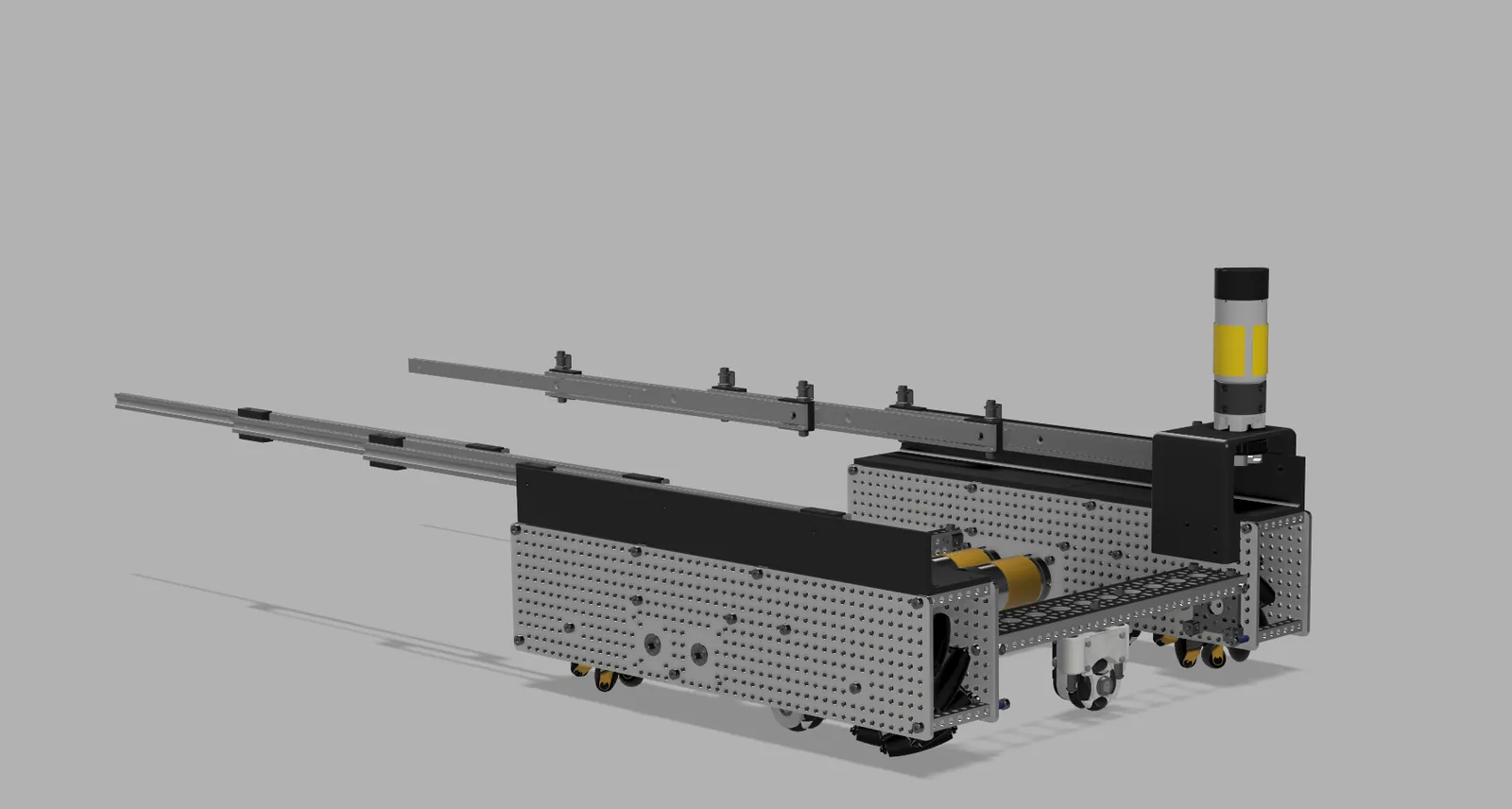
In the first CAD of the robot, on Sep 12, 2024, the extension ran on two slides, one on top of each side of the chassis. Across the two slides it was 15 in wide.
Five days later: one slide, 3 in wide
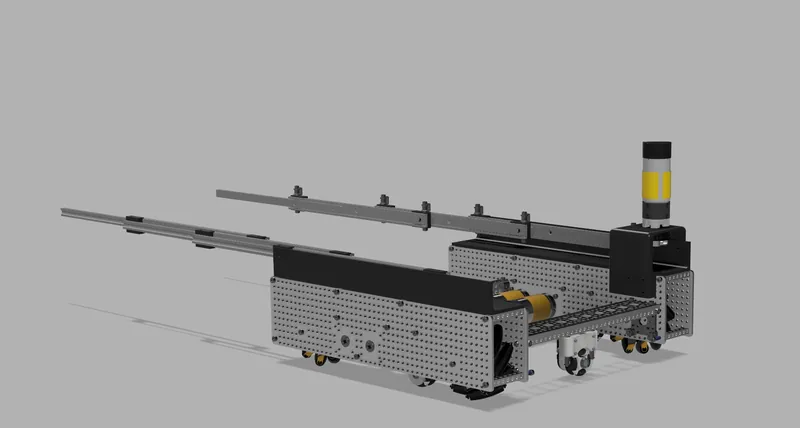
By Sep 17 it was a single slide inside the chassis, between the drive pods: 3 in wide instead of 15.
One narrow slide from then on
Up close, the new slide sits inside the chassis beside a drive pod. From then on the extension stayed one narrow slide for the rest of the season, through every intake that rode on it.
Four real renders of the robot from my CAD, five days apart; they are from different camera angles, so they follow each other rather than line up. The orange marks are drawn over the renders to pick out the extension; the widths are mine.
The game, and my part of the robot
In INTO THE DEEP, game pieces called samples start in a pile inside the submersible, a metal frame in the middle of the field. Robots reach in under its rails, pull samples out, and either score them in the baskets or bring them to the human player, who turns them into specimens that the robot clips onto the chambers.
I was the team captain. On the robot, my part was the horizontal extension: the slide that pushes the intake out across the floor and in under the submersible rail. This page follows that slide and the intake at its tip through the season, using our photos, renders and videos from kickoff on Sep 7, 2024 to the Chesapeake Championship on Mar 2, 2025. The timeline below puts the season's dated photos, renders and results in order; each one comes back further down the page, next to its part of the story.
The season at a glance
Sep 12, 2024
First CAD: two slides, 15 in wide
The first CAD of the robot: the extension runs on two slides, one on each side of the chassis Sep 14, 2024
Intake version 1, sketched
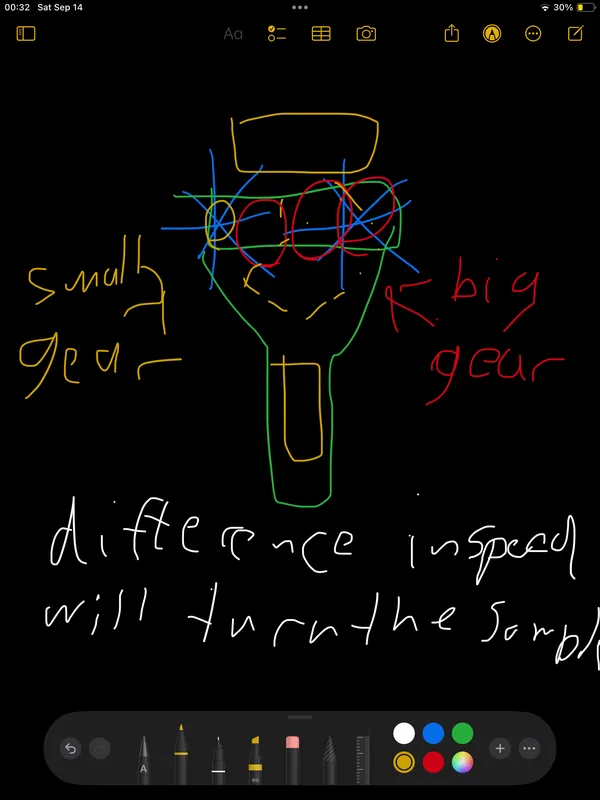
The first intake sketch: two spinners geared through a small gear and a big gear Sep 17, 2024
One slide, 3 in wide
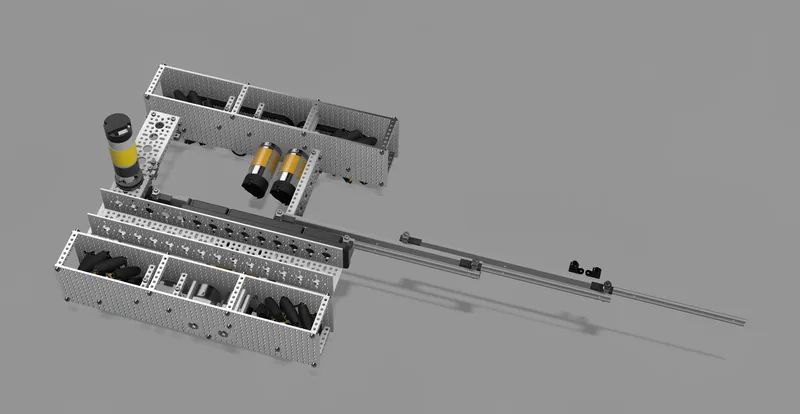
Five days after the first CAD: one slide inside the chassis Oct 12, 2024
Intake version 1, printed
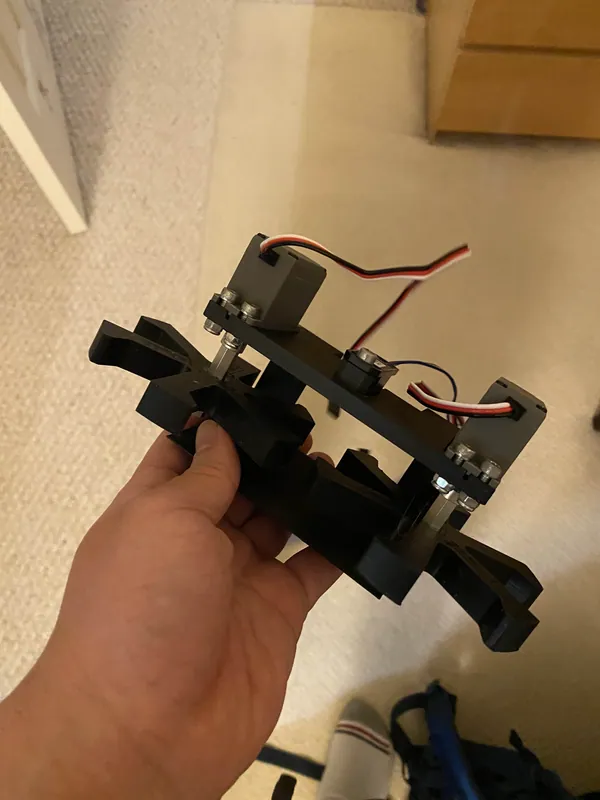
Version 1 printed, with two servos wired in Oct 20, 2024
The whole robot in CAD
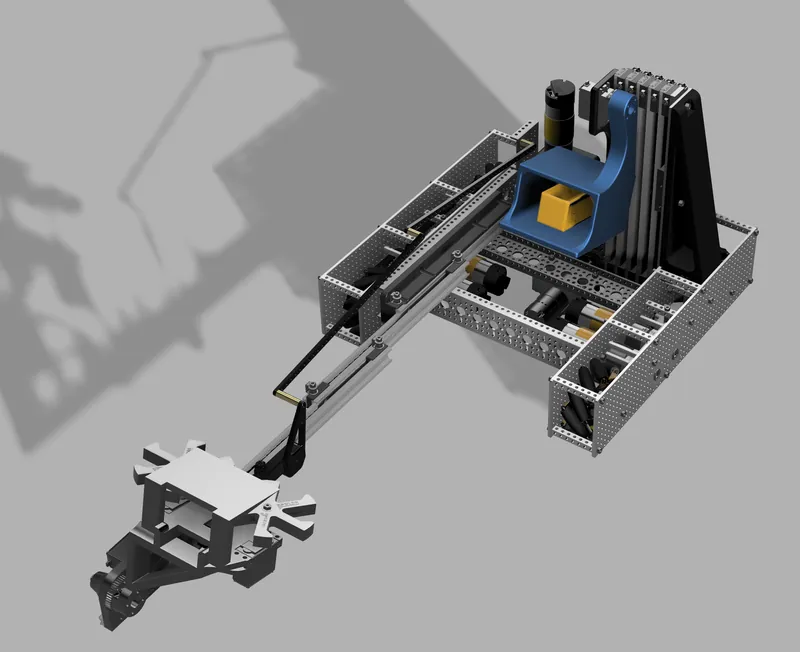
The first full robot in CAD, with the extension all the way out Dec 12, 2024
The slide, built
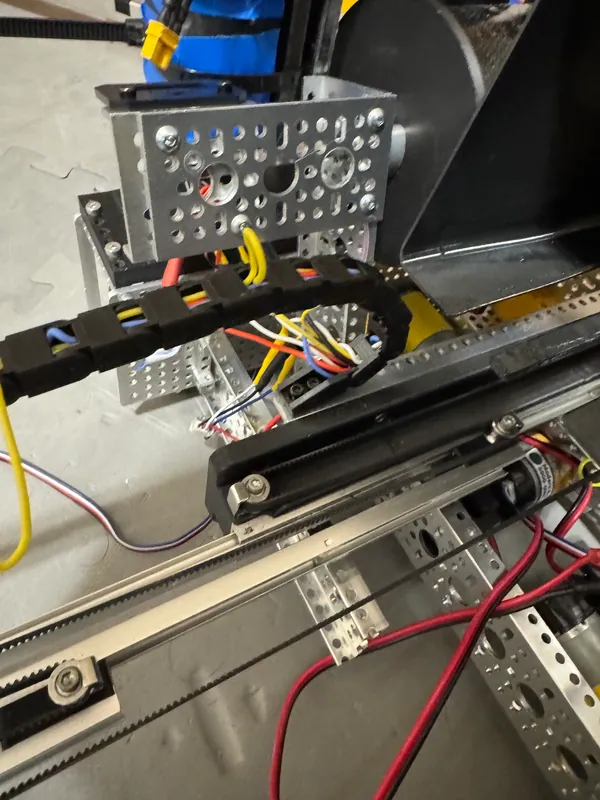
The built slide, with its belt and cable carrier Dec 13, 2024
Intake version 2
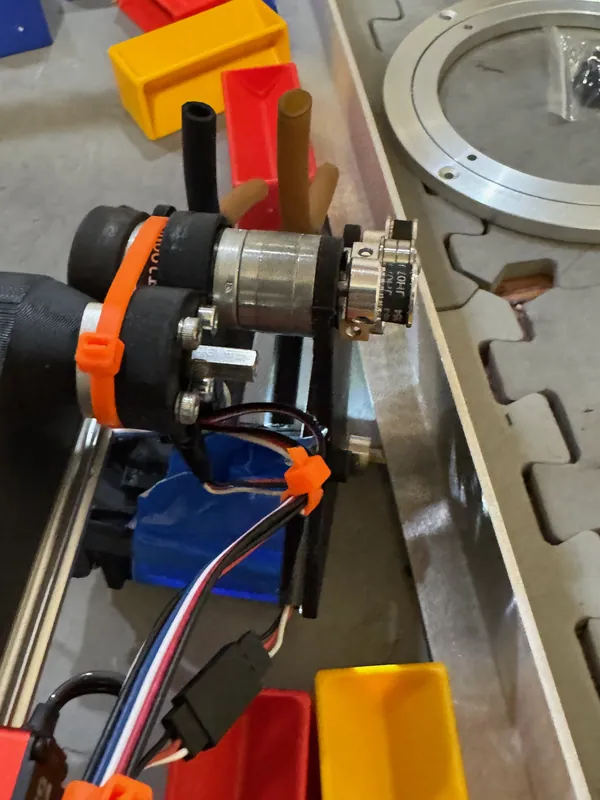
Two days before our first event: version 2, with surgical-tubing flaps on the roller Dec 15, 2024 · Glen Allen VA #2 Qualifier
First event: 5-0 and the Innovate Award
5-0 in qualification matches, captain of the finalist alliance, and the Innovate Award.
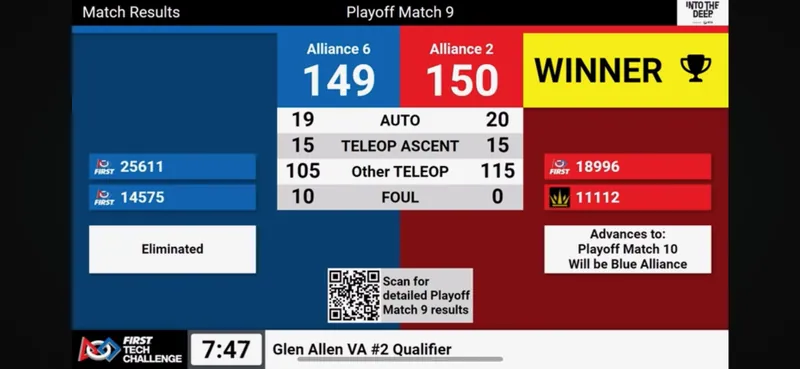
The livestream result card for playoff match 9: our alliance 150, the other 149 Jan 25, 2025 · Moorefield WV 1 Qualifier
The reworked intake: Innovate Award again
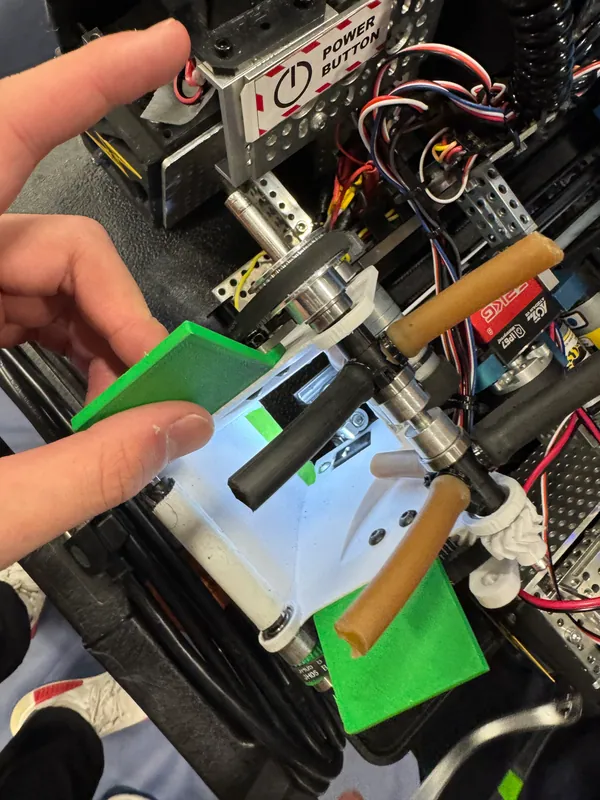
At the Moorefield qualifier, with the reworked intake Feb 3, 2025
Intake version 4
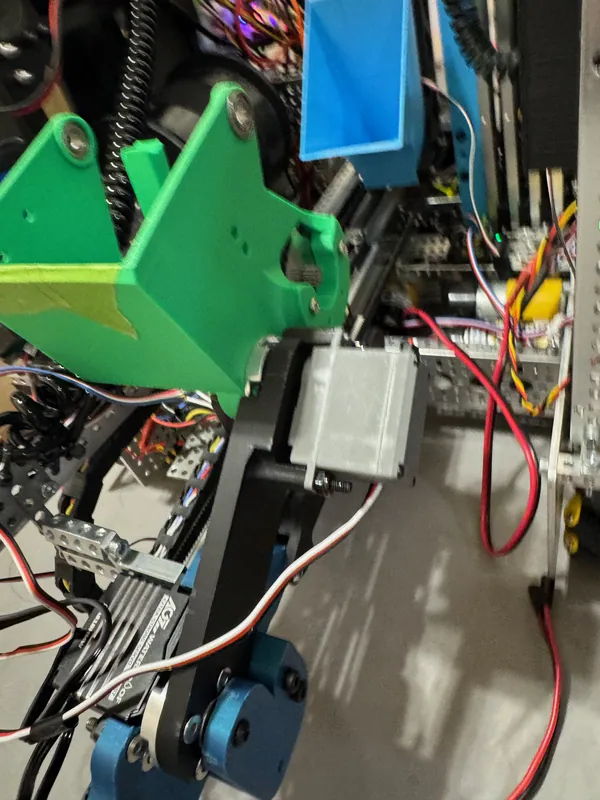
A green intake housing on its pivot arm Feb 22, 2025
Intake version 5, built
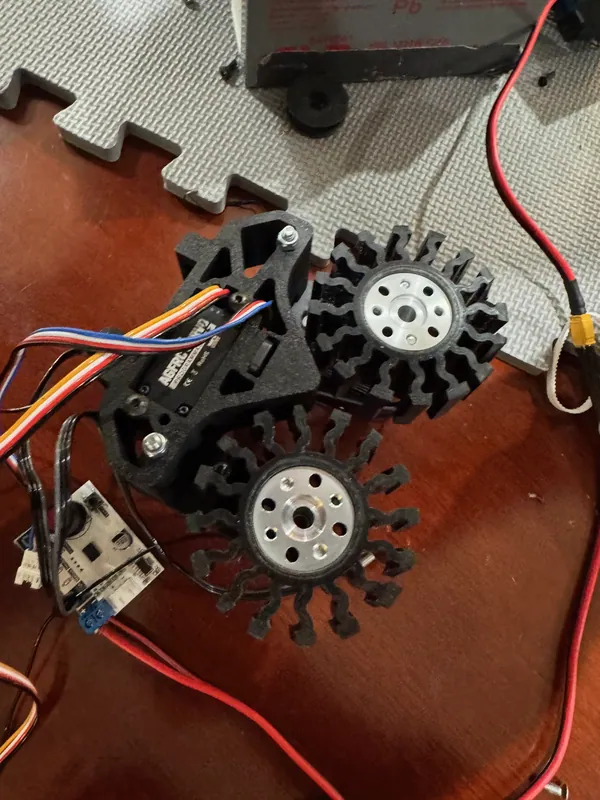
Ten days after its first hand-held prototype Mar 2, 2025 · FIRST Chesapeake Championship
1st place Think Award
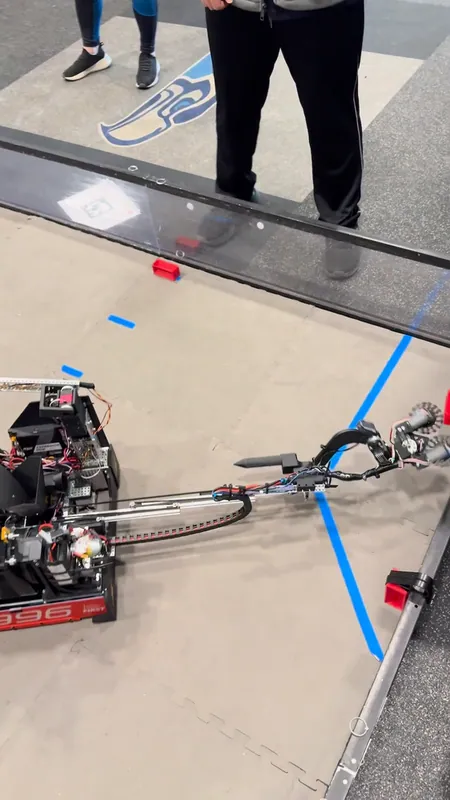
Fully extended on a practice field at the Chesapeake Championship


From CAD to the robot
Calculation How much of the robot's width did the extension take?
| Largest robot at the start of a match | 18 in wide, 18 in long, 18 in high | INTO THE DEEP game manual, rule R101 |
|---|---|---|
| Extension, first design (two slides) | 15 in across | my CAD, Sep 12, 2024 |
| Extension, one slide | 3 in | my CAD, Sep 17, 2024 |
- Two slides: 15 in / 18 in = 83 % of the widest robot allowed
- One slide: 3 in / 18 in = 17 %
- Width handed back to the rest of the robot: 15 in - 3 in = 12 in, two thirds of the 18 in
The single slide takes a sixth of the robot's width instead of five sixths, leaving 12 in more for the drive pods and everything else.
Measured against the 18 in limit, not our chassis, whose width is not on this page; rounded.

By Oct 20 the first full robot was in CAD. The slide reaches out of the front of the chassis with the intake at its tip, and a long link from the back of the chassis stretches out along it. Pulled in, the intake sits right beside the blue transfer bucket at the bottom of the lift.
On the built robot the slide has a timing belt along its rails and runs beside a cable carrier, the plastic chain that keeps the intake's wires from tangling as it moves in and out. In early November we filmed one of its first full cycles on the robot: reach out, grab a sample, pull back and drop it into the transfer bucket.


Catching on the rail
Problem The intake caught on the submersible rail
Reaching in under the submersible rail is the extension's whole job, and the rail is where it got stuck. In a December practice run the intake hung up on the rail ("it's stuck on the rail right now"). On the practice field at the Moorefield qualifier in January, a teammate had to reach in and free it by hand.
In a February test beside the submersible, the problem was the intake's width: it was wide enough to still catch on the submersible.
Fix A new head at the tip
Intake version 5 (below) replaced the head at the tip. Tried at the submersible in February, it looked "a lot more tolerant", and in the later tests the extension reaches in from several sides of the submersible and all the way out to the wall.
In the specimen autonomous at the top of this page, the robot works from the chamber and sends the extension across the field to fetch a sample by the wall.

The intake: five versions
The intake rides at the tip of the extension. It has to pick a sample up off the floor, often out of a pile under the submersible rail, and hold on to it while the extension pulls back. We went through five versions in one season, from two sideways spinners to the two top-down spinners we finished with.
Version 1 · Sep to Nov 2024
Two sideways spinners
The first idea is a page of sketches from Sep 14: two star-shaped spinners on either side of a funnel, one powered and the other free to roll. The next sketch gears them through a small gear and a big gear, and the note says why: the "difference in speed will turn the sample." It was in CAD the same day, and a printed prototype got its first test spun by a cordless drill. By Oct 12 the printed version had two servos wired in.
Problem Side rollers were picky about how the sample was lying
The first sketches already marked a case where a sample could get stuck. By late November, with the intake on the robot, the drive team traced the misses to the side rollers themselves: they only grabbed a sample lying the right way.
Fix
Version 2 dropped the side rollers for vertical spinners.
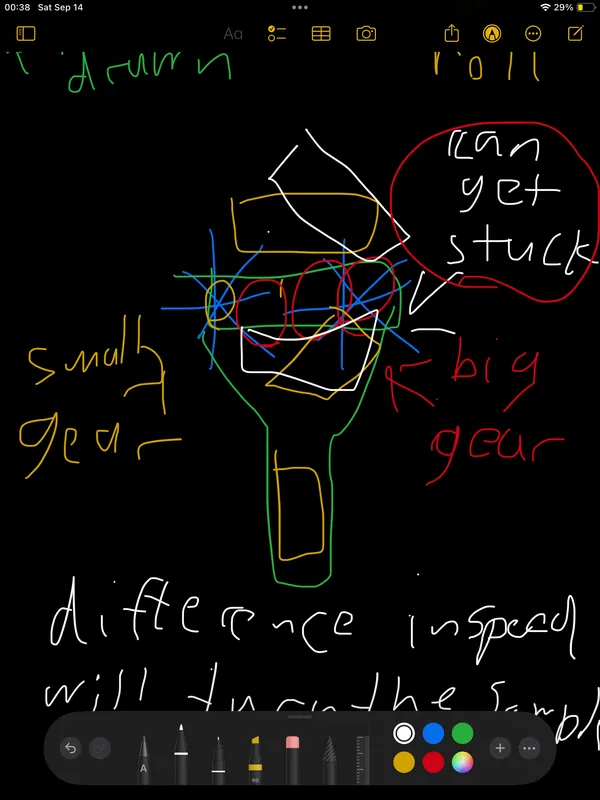
Sep 14, 2024: a small gear and a big gear, so the "difference in speed will turn the sample", and a red note where a sample "can get stuck" Oct 12, 2024: version 1 printed, with two servos wired in and a star spinner on each side Sep 2024: the first prototype, spun by a cordless drill Version 2 · Dec 2024
Vertical spinners
Version 2 grabs with spinning rollers that carry flaps of surgical tubing. Once it has the sample, the intake flips back and hands it to the bucket at the bottom of the lift.
Problem The hand off dropped samples, and parts collided
In bench tests in the days before our first event, some samples flipped and fell out during the hand off, and the bucket arm and the intake ran into each other ("this is colliding again").
Fix Test the hand off until it holds
We ran the hand off on the bench over and over: more than a dozen tests filmed from the same spot over those days. Within days the robot was running the whole sample autonomous: extend, grab, hand off, lift, score, and go again (the clip under Software on the robot).
Dec 13, 2024, two days before our first event: version 2 up close, with surgical-tubing flaps on the roller Dec 2024: rollers with surgical-tubing flaps spinning in front of a sample

The hand off, clean and failed
Two of those bench tests, filmed from the same spot: one clean, one failed. In both the sample starts in the intake with the bucket beside it, and the intake flips back to carry it over the top. Watch the failed one: the sample ends up lying flat across the top of the bucket instead of dropping in, then tips and falls out.
Step 3 · Dec 15, 2024
Competing with it
Version 2 is the intake we ran at our first event, the Glen Allen VA #2 Qualifier. The robot went 5-0 in qualification matches and ranked 2nd of 34, we captained the finalist alliance, and we won the Innovate Award sponsored by RTX. One playoff match we won 150 to 149.
Dec 15, 2024, the livestream result card for playoff match 9 at Glen Allen: our alliance (18996 and 11112) 150, the other 149 Version 4 · Jan to early Feb 2025
Reworking the vertical spinners
We kept vertical spinners and reworked them. In January a hand-held prototype with white side plates pulled a sample in straight on. The intake we ran at the Moorefield qualifier on Jan 25 had green side plates and surgical-tubing flaps. In early February we held a new green prototype over a sample at different angles, from about 45 degrees to straight down, to see how the approach angle changed the pick up.
Problem The list after testing
After a full test session on Feb 7 the whiteboard read: sample deposit backdoor is bad, intake belt skip, rejecting less powerful, specimen servo mount blocking intake for transfer. Two of those are the intake: the belt in its drive was skipping, and spitting out a sample of the wrong color was not strong enough.
Fix A new layout
Five days later, on Feb 12, we had the first prototype of a new layout in hand: version 5.
Jan 25, 2025, at the Moorefield qualifier: the reworked intake, with green side plates and surgical-tubing flaps 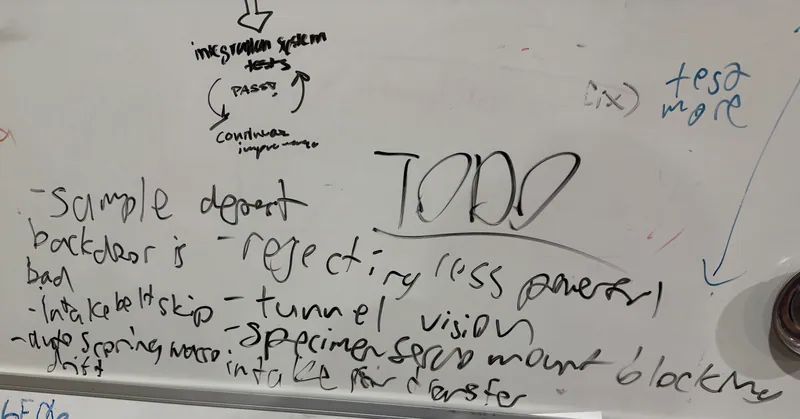
Feb 7, 2025: the to do list after testing, next to the loop we worked in: integration and system tests, then continuous improvement Feb 2025: holding a new prototype over a sample at different angles Version 5 · Feb 12 to Mar 2025
Two top-down spinners
The last version uses two star wheels side by side that come down on the sample from above and pull it up between them. It went from a hand-held prototype on Feb 12 to the Chesapeake Championship on Mar 2. In our autonomous run there, the head came down on each blue sample and picked it up, and the extension swung it over to the observation zone for the human player. The rows below go through it up close.
Mar 2, 2025, from the autonomous run at the top of the page: the head comes down on a blue sample and picks it up, the extension swings it over to the observation zone and lets it go, then it does the same with the next sample


The first prototype
The first version 5 was held in the hand and pressed down onto a sample on the floor. Its two star wheels were driven through orange O-ring belts that cross over. Crossing a belt reverses the direction it turns the wheel, so the two wheels spin opposite ways and both pull the sample up into the middle.


The linkage, in CAD
In the CAD, a disc on a servo drives two links that swing the wheel arms apart and back together, over a V-shaped funnel. From the front, the two compliant star wheels sit side by side under the printed frame.


Built and mounted
The assembled head is from Feb 22. By Feb 27 it was mounted on the end of the extension, three days before the Chesapeake Championship. On the robot the whole head rides on a wrist at the tip of the extension.
Spitting out the wrong color
Fix Rejection that works
"Rejecting less powerful" had been on the whiteboard. In a bench test of version 5 we fed it a red sample on purpose, and the wheels threw it straight back out.
This is the intake in the footage at the top of the page, on a practice field at the Chesapeake Championship.
The rest of the robot
The extension and intake feed everything else, which changed around them over the season:
- Lift and outtake. In October the lift was a multi-stage slide with a printed bucket. In December it became a black band that unrolls from a drum into a rising tube, with a bucket on a printed truss arm at the top. In January the bucket became a scoop on a taller truss arm.
- Specimens. A claw on a truss arm clips specimens onto the high chamber.
- Climb. In December the robot hooked the low rung and lifted itself off the floor. At Glen Allen the livestream called a level two climb.

Software on the robot
The robot's code is not in a public repository, so there is nothing to link. What the footage shows it doing:
- A sample autonomous (December, in this clip): reach out to each yellow sample on the spike marks, hand it off, lift and score in the high basket, then go again. At Glen Allen the livestream commentator counted all four samples in the high basket in one autonomous period.
- A specimen autonomous (February and March): the robot works from the chamber and sends the extension across the field to fetch samples for the human player.
- Color sensing. A color sensor sits at the intake. On a test day we read its raw red, green, blue and alpha values on the Driver Hub against each sample color, and the final intake throws a sample of the wrong color back out.
Results
This was S.T.A.T.I.C.'s most successful season: three official events, 12-12 overall, and an award at every one.
| Glen Allen VA #2 Qualifier | Moorefield WV 1 Qualifier | FIRST Chesapeake Championship, Dulaman Division | |
|---|---|---|---|
| Date | Dec 15, 2024 | Jan 25, 2025 | Mar 2, 2025 |
| Rank | 2 of 34 | 21 of 27 | 8 of 27 |
| Qualification | 5-0 | 1-4 | 3-2 |
| Playoffs | 2-2, captain of the finalist alliance | 0-2 | 1-2, division semifinalist |
| Award | Innovate Award sponsored by RTX | Innovate Award sponsored by RTX | Think Award, 1st place |
This team really shocked the judges with their innovative robot design.
From the judges' script for the Innovate Award at Glen Allen, Dec 15, 2024
Source: FIRST Tech Challenge event results for team 18996, 2024-25 season.