← All projectsS.T.A.T.I.C., FTC 18996Sep 2022 to Feb 2023
FTC POWERPLAY Robot
My first season as captain, and the team's first time advancing to regionals.
POWERPLAY was the 2022-23 FIRST Tech Challenge game: robots pick up plastic cones and drop them over poles called junctions. It was my first season as captain of S.T.A.T.I.C. (FTC 18996), and the idea behind our robot shows in every clip on this page: park beside the cones, keep the wheels still, and let a two-link arm carry each cone up and over the robot onto a pole.
We went 1-4 and 2-3 in qualification matches at our first two events, then 5-0 at the Union Bridge Qualifier a week later, ranked 3rd of 35 and won the Inspire Award 3rd Place. It was the team's first season advancing to the Chesapeake Championship.
The game, and our idea
In POWERPLAY, robots pick up plastic cones and drop them over poles called junctions, which stand in a grid across the field. Cones come from the human player at the side of the field and from stacks of five against the field wall.
2022-23 was my first season as captain. The idea behind our robot is simple to say: park next to the cones and a pole, and let the arm do the travelling instead of the wheels. One cycle is: reach down to the cone, close the claw, lift, swing up and over the top of the robot, let go over the pole, and swing back.

One cycle
The robot sits on a square of blue tape between the cones stacked at the wall and a pole, and stays on that square for the whole clip: only the arm moves.
The arm comes down over the side of the robot, and the claw drops over the top of a cone at the wall and closes on it. Both links swing up past vertical, carrying the cone over the top of the robot to the other side. Over the pole the claw lets go, and the cone slides down the pole onto the ones already there. Then the arm swings back down to the cones and the next cycle starts.
In this clip one cone takes about 5 seconds, drop to drop (timed from the video).
Calculation What does 5 seconds a cone add up to?
| One cone, drop to drop | about 5 s | timed from the clip beside this text |
|---|---|---|
| Driver-controlled period | 2 min = 120 s | REV, POWERPLAY game breakdown |
| Points for a cone on a junction | 2 (ground), 3 (low), 4 (medium), 5 (high) | same source |
- Cones in the driver-controlled period: 120 s / 5 s = 24
- Points: 24 × 2 = 48 on ground junctions, up to 24 × 5 = 120 on high junctions
At this pace, a robot that never moved its wheels could place about 24 cones in the driver-controlled period, worth 48 to 120 points depending on the junction.
An upper bound, not a match result: it assumes a cone is always there to take, and leaves out the end game and any driving.
It held up in a match
At the CHS-MD Union Bridge Qualifier on January 28, 2023, the stream commentator picked it out in our fifth qualification match of the day:
Blue's got a mechanism that's running without moving any wheels right now, just straight up stacking cones... cap after cap after cap.
Stream commentator, Union Bridge Qualifier, qualification 38
We won that match 157-106, our fifth win in five qualification matches that day. Right after it, a junction near our robot held a tall stack of blue cones.

The chassis
The robot drives on four mecanum wheels under a frame of aluminum channel, with a REV Control Hub and the wiring on top. Folded, the arm lies along the whole length of the chassis.


The arm, part by part

Two links
The arm has two links. The short lower link, with our 18996 number plate on it, pivots low on the chassis. The long upper link carries the claw at its tip; here both stand straight up, with the claw at the very top.
Stowed, the arm folds back on itself: the long link lies at an angle over the top of the robot, and the claw ends up above one end of the chassis, as in the photo at the top of this page.


Geared joints
The joints are geared. At the base of the arm a servo turns a small brass pinion, which meshes with a much larger aluminum gear beside a big aluminum tube hub.
Another servo does the same on the arm itself: a brass gear on the servo meshes with a large aluminum gear, next to the sprocket where a roller chain starts up the link.


Chain, tensioner and six servos
The roller chain runs up the long link. A small roller on a plate presses on it as a tensioner, to take up the slack.
Our Driver Hub names six servos, each with its position: Rotator, Extender, Cone, Popper, Release and Elbow.
How far it reaches
In this close-up from late January the arm unfolds from its stowed pose: the lower link stands up, the long link swings up until both are straight, and then the arm folds back down again. Straight up, the claw reaches well above the robot; at a demo at school on February 2 it held a cone high over the carpet.
Every joint we photographed works the same way, a small gear on a servo driving a much larger aluminum gear. On one, under a plate, a servo's brass gear meshes with a large gear that sits on a round bearing housing.


The claw: three versions
By Jan 4, 2023
A funnel with a ring
Our first claw was a black funnel with a closed teal ring, at the front corner of the robot.
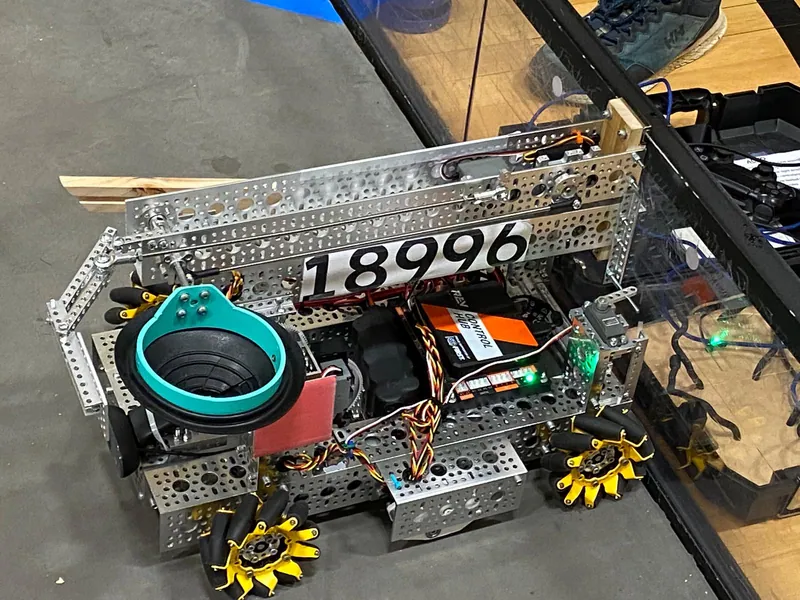
By Jan 4, 2023: the robot from above with the 18996 plate and the first claw, a black funnel with a teal ring, at the front corner Late January 2023
Two green C bands
By late January the claw at the tip of the arm was two green C-shaped bands, stacked one above the other.
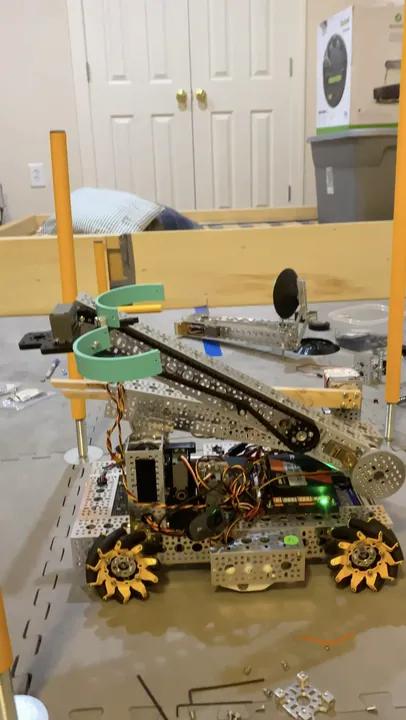
Late January 2023: the claw at the tip of the folded arm, two green C-shaped bands one above the other From January 31, 2023
A split funnel
From January 31 on, the claw is two black half-funnels with teal rims, on black mounting plates that carry a small servo.
The servo swings the two halves apart to open and back together to close. Closed, they make one funnel that drops over the tip of a cone, as it does over the top cone of a full stack of five at the start of the next section.
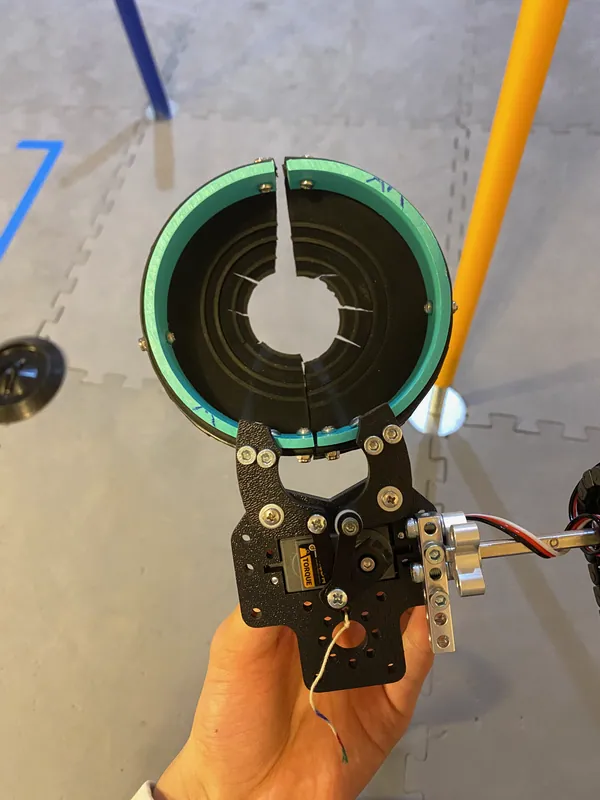
Feb 4, 2023: the split funnel closed, two black half-funnels with teal rims forming one ring 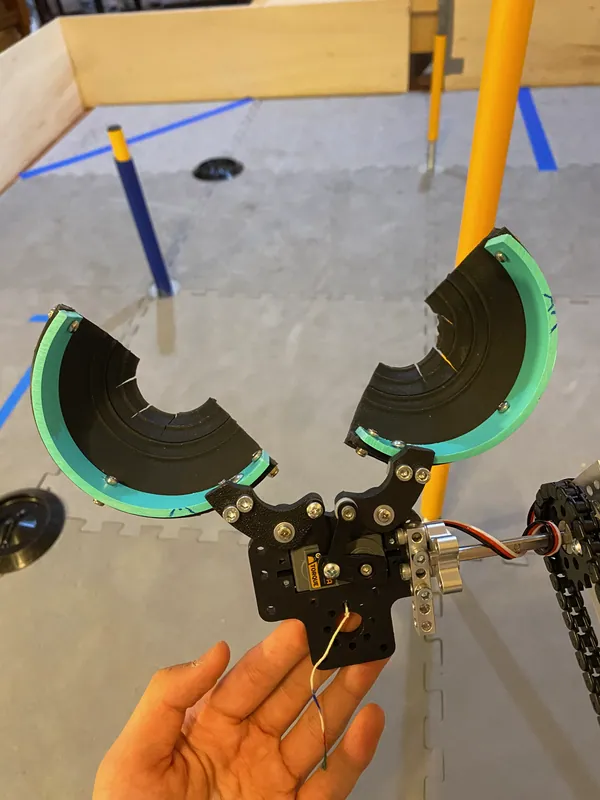
Feb 4, 2023: open, the two halves swung apart


Five cones, five heights
Cones against the wall come in stacks of five, and each cone in a stack sits at a different height, so the arm has to come in a little lower on every pass. The funnel closes over the top cone of a full stack.

The clip picks up with three cones left. The funnel comes down over the top one and lifts it clear; the arm comes back about four and a half seconds later and reaches a little lower for the next one. The last cone sits on the floor, the lowest pose of all.
In the full clip the arm takes all five cones off the stack in about 20 seconds (timed from the video).
Getting the stack right
Problem The stack tipped over
Stack pick up did not work at first. In one early test the claw came down over the top cone of a full stack and lifted it, and the other four cones tipped over and fell to the floor.
Problem Too slow
In another test, filmed from above, the mechanism worked but was too slow.
In later clips, the one above among them, the arm takes the stack apart without knocking it over, one cone about every four and a half seconds (timed from the video).
A run from the starting wall
The first clip at the top of this page is a test from the starting wall: the robot starts against the field wall with a cone already in the claw, drives across the field, turns onto its square of tape beside a pole, and raises the cone to the top of it. From there it stays put and cycles cones from the wall to the pole.
The second clip at the top shows that loop from higher up in the corner of the field: the stack at the wall, the pole on the other side, and our laptop and Driver Hub on the field floor. Filmed from straight above, the arm swings out over the side of the robot to the cones and back up over the chassis, while the chassis stays in one place.
Measuring the arm, the week of the Chesapeake Championship
Four days before the Chesapeake Championship we measured the arm. On February 7 we set a digital angle gauge on the arm's links and on the chassis and photographed each reading: more than 50 photos in twenty minutes.

The next day we held the Driver Hub up next to the arm and read off every servo's position, pose by pose. The screen lists the six servos by name, on the hub's network, 18996-RC.

In this side view from the same week the arm reaches down to the floor on one side of the robot, then both links go straight up.
The season in the official results
| Event | Date | Rank | Record | Awards and playoffs |
|---|---|---|---|---|
| Glen Allen Qualifier, VA | Dec 11, 2022 | 20 of 24 | 1-4 | Think Award 3rd Place |
| Harrisonburg Qualifier 1, VA | Jan 21, 2023 | 26 of 37 | 2-3 | |
| Union Bridge Qualifier, MD | Jan 28, 2023 | 3 of 35 | 5-0 | Inspire Award 3rd Place, Think Award 3rd Place, semifinal (1-2) |
| Chesapeake Championship, Scarlet Division | Feb 11, 2023 | 23 of 26 | 1-4 |
Problem A slow start
Our first two qualifiers went badly: 20th of 24 and 26th of 37, with 3 wins in 10 qualification matches.
A week after the second one we went 5-0 at the CHS-MD Union Bridge Qualifier and ranked 3rd of 35, and this was the team's first season advancing to the Chesapeake Championship. We photographed the result screen after each of our five qualification matches that day:


In the semifinal, with G-FORCE (2818), ranked 1st, and Lions (12718), we won one of three matches, 186-177, and went out (131-181, 186-177, 134-166).
Problem The Chesapeake Championship
At the Chesapeake Championship two weeks later we won one of our five counted matches and finished 23rd of 26 in our division. One of our six matches there was a surrogate match that did not count, and the closest loss was the last one, 142-148.
| Event | Qualification matches, our alliance's score first |
|---|---|
| Glen Allen | Q4 70-72, Q8 99-112, Q13 88-64, Q19 78-93, Q26 46-243 |
| Harrisonburg | Q2 39-46, Q13 87-35, Q22 61-134, Q32 100-74, Q45 43-108 |
| Union Bridge | Q3 97-43, Q10 133-48, Q20 125-101, Q29 157-87, Q38 157-106 |
| Chesapeake Championship | Q3 81-123, Q9 138-118, Q14 119-67 (surrogate, did not count), Q21 125-264, Q28 127-228, Q33 142-148 |
Source: the official FIRST event pages for team 18996, 2022 season. Team: S.T.A.T.I.C., FTC 18996; 2022-23 was my first season as captain.